
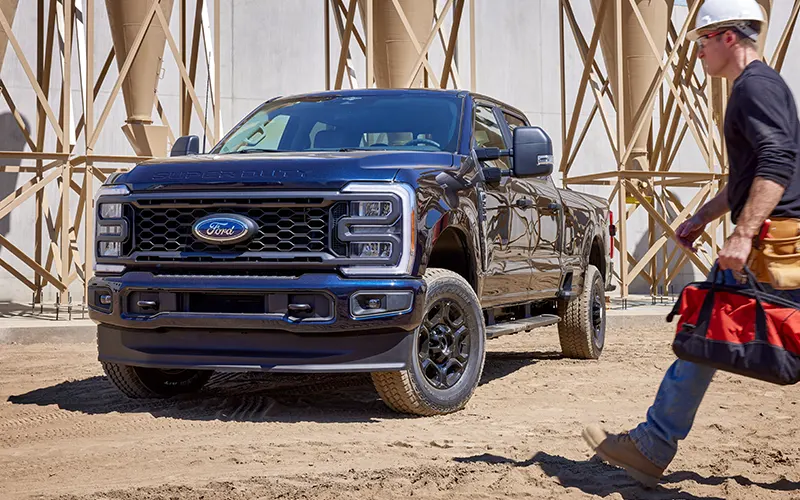
We get questions about Ford F-250 lug nut torque all the time in our service lane, so we put together a reference you can use at home. Correct torque keeps the wheel seated properly, protects the studs, and reduces the risk of vibration or wheel loss.
Below is a model year breakdown from our perspective as a Ford dealership, based on Ford factory manuals and industry torque charts our technicians use. All values assume factory wheels and hardware unless noted. Always double check your specific owner’s manual or the label in your truck, especially if wheels, studs, or hubs have been changed.
How To Use This Ford F-250 Lug Nut Torque Guide
-
Find your model year and configuration.
-
Confirm whether you have a standard 8 lug F-250, a 7 lug “light duty” F-250 from the late 1990s, or an older classic truck.
-
Use a quality torque wrench to tighten lug nuts in a star pattern to the value listed.
-
Recheck torque after a short shakedown drive.
If anything is unclear, our service team at Jim Burke Ford is always happy to confirm the correct spec for your exact VIN.
2020–2026 Ford F-250 Super Duty Lug Nut Torque
The current generation Super Duty F-250 uses M14 x 1.5 wheel studs with 8 lug hubs. Ford owner’s manuals for recent Super Duty models list a wheel lug nut torque of 165 lb-ft (224 Nm) for these studs, and that spec has remained consistent through the recent model years.
For 2020, 2021, 2022, 2023, 2024 and 2025 F-250 Super Duty trucks with factory 8 lug wheels, you can expect:
-
Recommended lug nut torque: 165 lb-ft
The 2026 F-250 continues on the same Super Duty platform and uses the same wheel and stud architecture. Although 2026 owner’s manuals are still being rolled out, there is no indication that Ford has changed the wheel hardware, so you should see the same 165 lb-ft spec in your 2026 manual. Once you take delivery, always verify the torque in the book in your glovebox.
We also recommend:
-
Tighten in a star pattern
-
Recheck torque at roughly 100 miles after any wheel or tire service, which matches the retorque guidance in Ford’s service literature.
2011–2019 Ford F-250 Super Duty Lug Nut Torque
For the 2011 through 2019 Ford F-250 Super Duty, Ford moved fully to metric wheel studs on the 8 lug hubs. Owner’s manuals from this era list 165 lb-ft as the wheel lug nut torque for M14 x 1.5 studs.
For 2011, 2012, 2013, 2014, 2015, 2016, 2017, 2018 and 2019 F-250 Super Duty models (SRW and DRW) on factory 8 lug wheels:
-
Recommended lug nut torque: 165 lb-ft
Some aftermarket charts list higher values for dual rear wheel medium duty applications, but for a typical F-250 Super Duty on stock wheels, 165 lb-ft is the correct target. When in doubt, follow the value printed in the owner’s manual or on any updated labels Ford may have applied during recalls or service campaigns.
2005–2010 Ford F-250 Super Duty Lug Nut Torque
For 2005 through 2010 Super Duty F-250 models, Ford manuals specify a slightly lower torque for the M14 x 1.5 lug nuts than later trucks. In the 2006 F-250 / F-350 / F-450 / F-550 owner’s guide, Ford lists:
-
Bolt size: M14 x 1.5
-
Lug nut torque: 150 lb-ft (about 200 Nm)
That same 150 lb-ft spec applies broadly across 2005, 2006, 2007, 2008, 2009 and 2010 F-250 Super Duty models with factory 8 lug wheels. Industry charts that summarize this era list 150 lb-ft for 2005–2010 F-250 / F-350 Super Duty trucks as well.
Our recommendation for any 2005–2010 F-250 on stock wheels:
-
Standard lug nut torque: 150 lb-ft
If your truck has aftermarket wheels that use a different style of nut (for example, conical “acorn” nuts), the wheel manufacturer’s torque spec may be lower. In that case, follow the wheel maker’s recommendation or ask our service advisors to look it up by part number.
1999–2004 Ford F-250 Super Duty Lug Nut Torque
The first generation Super Duty F-250 arrived for the 1999 model year. These trucks use 8 lug hubs with metric studs, and Ford’s torque specification evolved slightly due to a factory revision.
Ford service information and several torque charts list:
-
1999–2004 F-250 / F-350 Super Duty, 8 lug: 150–165 lb-ft
Ford issued updated guidance in the early 2000s that effectively raised the standard toward the upper end of that range, and many owner’s manuals or replacement labels show 165 lb-ft as the revised spec.
For 1999, 2000, 2001, 2002, 2003 and 2004 F-250 Super Duty trucks with factory 8 lug wheels:
-
Earlier documentation: 150–165 lb-ft range
-
Practical recommendation today: torque to 165 lb-ft unless your owner’s manual or a label in the door jamb clearly specifies a different value
At Jim Burke Ford, when we have a 1999–2004 F-250 in the shop on OE style wheels, our technicians typically set wheel torque to 165 lb-ft and note any special labels or instructions on the work order.
1997–1999 F-250 Light Duty 7 Lug Lug Nut Torque
There is an often forgotten model in this story. In the late 1990s Ford sold an “F-250” light duty pickup that shared a lot with the F-150 and used 7 lug hubs. On those trucks, the torque spec is lower than on the full Super Duty.
Torque charts that break out this configuration list:
-
1997–1999 F-250, 7 lug 16 inch light truck wheels: 100 lb-ft
If you own a 1997, 1998 or 1999 F-250 with 7 lug wheels, use 100 lb-ft unless your owner’s manual specifies otherwise. If you are not sure whether you have the 7 lug or 8 lug version, count your studs before you torque.
1986–1997 Ford F-250 8 Lug Lug Nut Torque
For the heavy duty 8 lug F-250 trucks in the late 1980s and 1990s before the Super Duty nameplate, most references agree on a 140 lb-ft spec.
Industry torque charts that cover 1986 through 1997 F-250 models list:
-
1986–1997 F-250 8 lug, 16 inch wheels: 140 lb-ft
So for 1986, 1987, 1988, 1989, 1990, 1991, 1992, 1993, 1994, 1995, 1996 and the 8 lug 1997 F-250:
-
Recommended lug nut torque: 140 lb-ft
As these trucks age, many have non-original wheels or upgraded studs. If you are restoring or modifying one of these classics, verifying stud size and following the wheel manufacturer’s torque spec becomes very important.
1953–1985 Ford F-250 Lug Nut Torque
The earliest F-250 models date back to the 1950s. Factory manuals from the 1960s and 1970s specify torque values by stud size rather than by model name. A period Ford truck service manual excerpt shows guidance such as:
-
1/2–20 wheel studs: 65–90 lb-ft
-
9/16–18 wheel studs: 125–175 lb-ft
Most three quarter ton F-250 trucks of this era use the larger 9/16 inch studs, and practical torque charts for older F-250 pickups commonly list a recommended wheel torque around 140 lb-ft for 1980s and late 1970s trucks.
For simplicity, if you own a 1953 through 1985 F-250 and you are on stock style 8 lug wheels:
-
If you confirm 9/16 inch studs: target 140 lb-ft within the 125–175 lb-ft range
-
If you confirm 1/2 inch studs: stay closer to 80–90 lb-ft
Because there was more variation in wheels and hardware in this era, we strongly recommend checking an original shop manual for your exact year or letting our technicians verify the hardware and set torque for you.
Quick Ford F-250 Lug Nut Torque Reference Table
Here is a simple summary you can save or print. Values are for typical factory style wheels and studs:
-
2020–2026 F-250 Super Duty, 8 lug: 165 lb-ft
-
2011–2019 F-250 Super Duty, 8 lug: 165 lb-ft
-
2005–2010 F-250 Super Duty, 8 lug: 150 lb-ft
-
1999–2004 F-250 Super Duty, 8 lug: 150–165 lb-ft, with 165 lb-ft used in updated guidance
-
1997–1999 F-250 light duty, 7 lug: 100 lb-ft
-
1986–1997 F-250 heavy duty, 8 lug: 140 lb-ft
-
1953–1985 F-250, 8 lug: generally 140 lb-ft for 9/16 inch studs, 80–90 lb-ft for 1/2 inch studs, verify by stud size and manual
If you are unsure which group your truck falls into, we can look it up quickly by VIN.
Tips For Torquing Ford F-250 Lug Nuts Correctly
A correct torque number is only part of the equation. How you reach that number matters just as much.
Our technicians follow a few best practices drawn from Ford’s guidelines and general wheel service standards:
-
Clean all mating surfaces
Remove rust, dirt and corrosion from the hub face and wheel mounting surface so the wheel sits flat. -
Never lubricate the stud threads
Ford torque values assume clean, dry threads. Oil or anti-seize can change the clamping force and lead to over-tightening. -
Use a hand torque wrench
Impact guns are fine for removal and initial snugging, but final torque should be done with a calibrated torque wrench. -
Tighten in stages
Bring the nuts up in two or three passes in a star pattern until you hit the final spec. -
Retorque after driving
After any wheel disturbance, recheck torque after 50–100 miles of normal driving to account for seating and thermal cycles.
Doing this at home gets you very close to the way we service wheels in the dealership shop.
When To Let Jim Burke Ford Handle Your Wheel Torque
If you do not have a torque wrench that reaches 150 or 165 lb-ft, or you are not sure which torque applies to your specific F-250, we can help. Our technicians:
-
Look up torque specs by VIN in Ford’s service information
-
Verify wheel and stud size if anything appears non-standard
-
Use professional grade torque equipment and follow proper patterns and retorque procedures
Any time we rotate tires, mount new tires, or service brakes on an F-250, wheel torque is part of the job. You can also stop by and ask us to check torque after a local tire shop has worked on your truck.
Conclusion: Keeping Your F-250 Safe And Secure On The Road
Correct lug nut torque is a small detail that has a big effect on safety, ride quality, and component life. From classic F-250 work trucks to the latest 2026 Super Duty models, there are specific torque values that apply to each generation, and our goal at Jim Burke Ford is to make those numbers easier to understand.
Use this guide as a quick reference, confirm the spec in your owner’s manual for your exact year, and do not hesitate to reach out to our service team if you want us to verify or set lug torque for you. Whether you are installing winter wheels, rotating tires in your driveway, or planning a long trip with a trailer, we are here to help you keep your Ford F-250 safe, secure and ready to work.


