
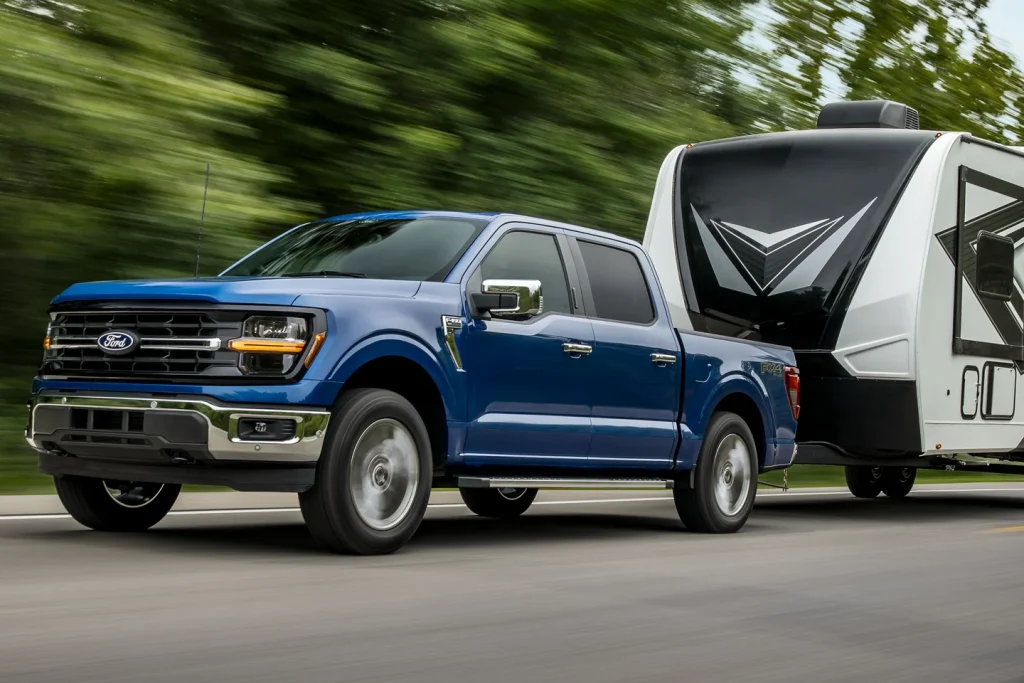
Planning an RV adventure means thinking through every detail, and one of the biggest questions many Ford owners ask is whether their vehicle can tag along behind their motorhome. The answer matters more than you might think. Choose the wrong towing method or try to flat tow an incompatible vehicle, and you’re looking at transmission damage, warranty issues, and thousands of dollars in repairs.
The good news? Several Ford models are specifically engineered for flat towing, giving you the freedom to bring a reliable vehicle along for those side trips to local attractions or scenic detours to places like Pismo Beach or Sequoia National Park. If you’re ready to explore current Ford models that meet flat-tow requirements, we can help you find the right match for your RV lifestyle.
This guide breaks down everything you need to know about Ford flat-tow vehicles. We’ll cover the latest 2026 models approved for four-wheel towing and walk through the verification steps that protect your investment.
What Is Flat Towing and Why Ford Owners Choose It
Flat towing, also called dinghy towing or four-wheel towing, means pulling a vehicle behind your RV with all four wheels rolling on the pavement. Unlike other towing methods, this approach requires no additional equipment beyond a tow bar, base plate, safety cables, and supplemental braking system.
RV enthusiasts love flat tow vehicles because of the convenience factor. You can unhook your car or truck in minutes once you reach your campground. No backing a trailer into tight spaces. No storing a dolly. Many Ford owners specifically seek out flat-towable vehicles because they want Ford’s reliability without sacrificing mobility during their travels.
Here’s the thing about flat towing: it requires specific transmission and drivetrain configurations. Vehicles must allow the transmission to remain in neutral without circulating fluid through the system, or they need a system that properly lubricates components even when the engine isn’t running. Not every vehicle meets these requirements. That’s why checking your specific model’s compatibility matters before hooking up that tow bar.
Flat Towing vs. Dolly Towing vs. Trailer Towing: Key Differences
Each towing method serves different needs and comes with distinct advantages:
| Towing Method | Description | Wheels on Ground | Pros | Cons |
| Flat Towing | All four wheels on road, connected via tow bar | 4 | Simplest setup, no ramping, maintains vehicle drivetrain | Limited to vehicles with Neutral Tow Mode; needs supplemental brakes |
| Dolly Towing | Front wheels on two-wheel dolly, rear wheels on ground | 2 (rear) | Easier for FWD vehicles without neutral mode | Heavier than flat towing, wears rear tires unevenly |
| Trailer Towing | Vehicle fully loaded onto trailer | 0 | Works with any vehicle | Bulkiest, heaviest, requires ramping and more storage space |
Flat towing keeps things simple. You attach the tow bar to your vehicle’s front end, engage neutral or the appropriate transfer case setting, and hit the road. The setup process takes just a few minutes once you’ve installed the base plate and wiring. Unhooking at your destination is equally quick. You don’t sacrifice much fuel economy compared to other methods, and you have immediate access to your vehicle without any unloading process.
Dolly towing positions the front wheels on a small two-wheel trailer while the rear wheels roll on the ground, but it adds complexity with storage needs and loading requirements. Trailer towing loads your entire vehicle onto a flatbed. Works for any vehicle regardless of drivetrain, but you’ll need significant storage space and it adds considerable weight to your setup.
2026 Ford Models Approved for Flat Towing
Ford designs several vehicles with the RV lifestyle in mind, engineering their drivetrains and transfer cases to handle flat towing without damaging critical components. The 2026 lineup offers options across different vehicle categories to match various needs and preferences. All flat-towable Ford models require Neutral Tow Mode engagement.
Ford recommends using a supplemental brake system on any towed vehicle, and many states legally require one for towed vehicles over a specified weight. Check the regulations in every state you plan to travel through before your trip.
2026 Ford Bronco: Trail-Ready and Tow-Ready
The Bronco stands out as one of the most capable Ford flat-towable vehicles, combining legendary off-road prowess with RV-friendly features. All 4×4 Bronco trims qualify for flat towing, using Neutral Tow Mode in the transfer case to let all four wheels roll freely without engaging the transmission or drivetrain components.
What makes the Bronco particularly appealing is its dual purpose. Use it as your daily driver, tackle challenging trails on weekends, then hook it up behind your RV for extended trips. The removable doors and roof options mean you can customize your adventure vehicle while maintaining flat-tow capability.
2026 Ford F-150: America’s Best-Selling Truck Behind Your RV
The F-150’s popularity extends beyond its work truck credentials. Four-wheel-drive F-150 trims including XL, XLT, Lariat, King Ranch, Platinum, Tremor, and Raptor can be flat towed when equipped with the neutral-ready transfer case. The truck’s utility makes it valuable at campsites and beyond. Haul firewood, serve as a reliable commuter vehicle at your destination, or transport the family into town.
The spacious cabin provides comfortable seating for family trips, and the truck bed accommodates camping gear or supplies. Once you’ve set up camp, the F-150’s towing capacity means you can even pull a smaller boat or trailer for additional recreation.
2026 Ford Ranger: Compact Capability Returns to Flat Towing
The Ranger brings midsize truck versatility to flat towing with all 4×4 models qualifying for dinghy towing. Its more compact dimensions make it easier to maneuver in tight parking lots and narrow mountain roads compared to full-size trucks. You still get genuine capability both on and off pavement.
The current-generation Ranger gained flat-tow approval starting with the 2025 model year. The 2024 Ranger was not eligible due to a braking system incompatibility introduced with the new generation, which Ford resolved for 2025 and carried forward into 2026.
The Ranger’s reduced weight puts less strain on your RV’s engine and brakes during long hauls, while improved fuel efficiency benefits both daily driving and towed scenarios. The truck bed still accommodates plenty of cargo for camping trips, and available off-road packages handle rough terrain with confidence.
2026 Ford Maverick: Hybrid Efficiency Meets RV Lifestyle
The Maverick represents an innovative approach to flat-towable vehicles by combining hybrid efficiency with compact truck practicality. Only Maverick models equipped with the 2.5L hybrid engine (both FWD and AWD) qualify for flat towing. The 2.0L EcoBoost engine is NOT eligible due to drivetrain limitations.
The hybrid powertrain delivers impressive fuel economy when driving independently, helping offset the costs of RV travel. Despite its compact exterior, the Maverick provides a useful bed for gear and supplies, along with a comfortable cabin that seats up to five passengers. Its urban-friendly size makes city navigation easier when exploring metropolitan areas during your travels.
2026 Ford Expedition: Full-Size SUV for Extended Adventures
The Expedition delivers three-row seating capacity and substantial cargo space, making it ideal for families who travel together. All 4WD Expedition trims can be flat towed, giving RV owners access to a vehicle that comfortably transports larger groups for day trips away from the campground.
You can fold down rear seats to load significant amounts of gear, or keep all rows upright to accommodate family and friends. Climate control, entertainment systems, and advanced safety features make long drives more comfortable. Available off-road packages handle dirt trails leading to remote campsites.
2026 Ford Explorer: Three-Row Versatility for RV Travelers
The Explorer offers another option for RV owners who need to bring a capable, family-friendly SUV on extended trips. Select 4WD Explorer trims qualify for flat towing using Neutral Tow Mode. The three-row seating accommodates families and groups, while available technology and safety features make it a comfortable choice for long drives away from the campground. Verify your specific trim and drivetrain configuration against Ford’s official RV and Trailer Towing Guide before hooking up, as eligibility varies by build.
2026 Ford Super Duty F-250, F-350 and F-450: Heavy-Duty Flat-Tow Options
The Super Duty lineup brings serious capability to flat towing scenarios. Four-wheel-drive Super Duty configurations with 2-speed transfer cases in Neutral Tow Mode qualify for flat towing. These trucks appeal to RV owners who need heavy-duty capability at their destination for hauling boats, ATVs, or other recreational equipment.
The Super Duty’s robust frame and powerful engine options deliver unmatched towing and hauling capacity once you reach your destination. The trade-off comes in fuel economy and the added weight your RV must pull. You’ll need a more powerful motorhome and careful attention to weight ratings.
Ford Models NOT Approved for Flat Towing
Understanding which Ford vehicles cannot be flat towed protects you from expensive mistakes. The Ford Bronco Sport lacks a neutral transfer case position and is NOT approved for flat towing. Front-wheel-drive models across Ford’s lineup typically lack flat-tow capability because their transmission design requires the engine to run for proper lubrication.
The Ford Escape represents a popular crossover that does not qualify for flat towing in standard configurations. Electric vehicles like the Mustang Mach-E face limitations because their motors connect directly to the wheels, creating resistance and potential damage when towed with wheels on the ground.
Try to flat tow an unapproved vehicle and you can destroy the transmission within just a few miles. Warranties often become void if you flat tow an unapproved vehicle, leaving you responsible for repair costs that can exceed $5,000.
How to Verify Your Ford’s Flat-Tow Eligibility
Check Your Owner’s Manual and Ford’s Official Towing Guide
Your owner’s manual serves as the definitive source for flat towing information specific to your vehicle. Look for sections covering recreational towing, dinghy towing, or four-wheel towing to find detailed procedures and restrictions. Ford provides explicit instructions for approved vehicles, including transfer case positioning, transmission settings, and any special requirements.
The manual typically includes weight restrictions, maximum towing speeds, and distance limitations you must follow to maintain warranty coverage. Skip required procedures and you can cause damage even on approved vehicles.
When the owner’s manual doesn’t clearly address flat towing, Ford’s official RV & Trailer Towing Guide provides comprehensive information for current model years. You should cross-reference with your specific vehicle configuration, as capabilities vary by trim level and optional equipment packages.
Confirm Your Exact Build Before You Tow
Vehicle configurations change between model years, and optional equipment packages can affect eligibility. Verify your specific build rather than assuming all versions of a model qualify. This approach protects you from problems down the road.
For used Ford vehicles or personalized guidance, our team at Jim Burke Ford in Bakersfield can help verify whether your specific vehicle configuration qualifies for flat towing. Bring your VIN number and we’ll access detailed specifications for your exact build. You can also schedule a service appointment with our Ford-certified technicians who understand the maintenance requirements for vehicles used in flat towing scenarios.
Find Your Flat-Towable Ford at Jim Burke Ford
Searching for Ford flat-tow vehicles leads many Central Valley residents to Jim Burke Ford, where a comprehensive inventory of new and used Ford vehicles includes models specifically suited for RV enthusiasts. Our sales team understands the unique requirements flat towing places on vehicles and can identify which available models meet your needs.
As a third-generation, family-owned and operated dealership, our service center employs Ford-certified technicians who understand flat towing maintenance requirements. From installing aftermarket base plates to performing regular inspections, they’ve got you covered. The parts department stocks components needed for proper flat towing setup and can order specialized equipment when necessary.
Whether you’re shopping for a new 2026 Bronco to accompany your RV adventures or exploring flat-towable options that fit your budget, our downtown sales showroom and Automall location provide convenient access. Our finance team works with customers to structure loans or leases that account for your intended use.
For RV owners throughout the Central Valley seeking reliable Ford flat-tow vehicles backed by knowledgeable service and support, contact our team at Jim Burke Ford. We combine inventory depth with the expertise that makes vehicle ownership more enjoyable.
Important Note: Always verify current model year specifications with official Ford documentation, as engineering changes occur between model years. Proper setup following Ford’s exact specifications maintains warranty coverage and protects your investment.


