
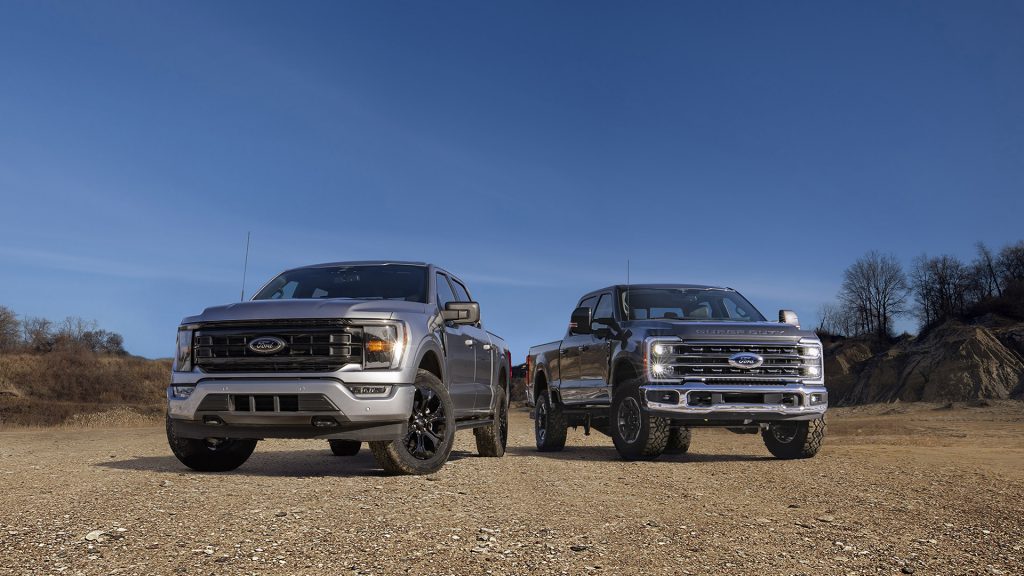
Choosing between the 2026 F-250 and F-350 seems simple until you actually start digging into it. Both trucks look nearly identical, share the same engine lineup, and run on the same platform. But the structural differences underneath have real consequences for what you can safely pull and haul. The question is never which truck is better. It’s which one actually matches your trailer weight, bed load, and job type.
If you’re ready to start comparing trim levels and configurations, browse our current 2026 Super Duty inventory at Jim Burke Ford.
F-250 vs. F-350: How They’re Actually Different
The engine options are identical across both trucks. Ford offers all four powerplants on the F-250 and the F-350:
| Engine | Type |
| 6.8L V8 | Gas — entry-level power |
| 7.3L V8 | Gas — strong payload performance |
| 6.7L Power Stroke® V8 Turbo Diesel | Diesel — strong towing |
| 6.7L High-Output Power Stroke V8 Turbo Diesel | Diesel — 1,200 lb-ft torque, max capability |
The real difference lives underneath the truck. Ford engineered the F-350 with a heavier-duty chassis and reinforced suspension compared to the F-250. That structural gap is what produces the F-350’s higher towing and payload ratings, and it also affects ride quality, handling under load, and long-term durability under sustained heavy use.
The F-250’s slightly lighter suspension tends to feel more compliant when the bed is empty, which matters for buyers who use the truck as a daily driver between jobs. The F-350’s stiffer setup is built for load-bearing. Neither is objectively better, but the difference is noticeable once you’re behind the wheel.
Side-by-Side Comparison
| F-250 | F-350 SRW | F-350 DRW | |
| Max Conventional Towing | 22,000 lbs | 25,000 lbs | 25,000 lbs |
| Max Gooseneck Towing | 22,300 lbs | 27,600 lbs | 38,600 lbs |
| Max Fifth-Wheel Towing | 31,000 lbs (with available High-Capacity Axle Upgrade Package) | — | — |
| Max Payload | 4,302 lbs | 4,706 lbs | Up to 8,000 lbs |
| Axle Config | SRW | SRW | DRW |
Towing Capacity
2026 F-250 Towing
Ford built the F-250 to handle a wide range of towing scenarios. Boat trailers, campers, horse trailers, lighter equipment loads, all well within its ratings.
| Setup | Max Capacity |
| Conventional towing (6.7L diesel) | 22,000 lbs |
| Fifth-wheel (6.7L diesel) | 23,500 lbs |
| Gooseneck (6.7L diesel) | 20,900 lbs |
| Gooseneck (6.7L HO diesel) | 22,300 lbs |
| Conventional towing (7.3L gas) | 18,200 lbs |
For most personal and light commercial towing, the F-250 delivers more than enough. Unless you’re regularly pushing the upper end of what a heavy-duty truck can handle, there’s no practical reason to step up to the F-350.
2026 F-350 Towing
The F-350’s ceiling is where the truck earns its place in agriculture, construction, and commercial fleet work. Large horse trailers, heavy equipment, commercial flatbeds, big gooseneck rigs, these are the applications where the capacity gap stops being a spec sheet number and becomes a real-world constraint.
| Setup | Max Capacity |
| Conventional towing (SRW) | 25,000 lbs |
| Gooseneck (SRW) | 27,600 lbs |
| Gooseneck (DRW, 6.7L HO diesel) | 38,600 lbs |
For contractors hauling equipment across Central Valley job sites, or farmers moving irrigation rigs, the F-350 provides the performance and rated compliance that commercial loads demand. Knowing the truck is rated for exactly what you’re asking of it isn’t abstract reassurance. It’s a genuine working advantage.
Payload Capacity
| Truck / Config | Max Payload |
| F-250 (7.3L gas) | 4,302 lbs |
| F-250 (6.7L diesel, most configs) | 3,300+ lbs |
| F-350 SRW | 4,706 lbs |
| F-350 DRW | Up to 8,000 lbs |
The F-350 DRW pulls ahead most clearly here. Dual rear tires distribute weight more effectively, which raises rated payload and reduces component stress under load. If your work involves routinely loading the bed close to capacity with materials, tools, or equipment, the DRW gives you significantly more room to operate.
That said, the F-250 handles substantial bed loads confidently. For buyers whose payload needs stay in moderate ranges, it holds its own without the wider stance and added bulk of a dually setup.
Cab and Bed Configurations
Both trucks offer identical cab and bed options:
Cabs: Regular Cab (up to 3 passengers), SuperCab, Crew Cab (up to 6 passengers)
Beds:
- 6.75-ft bed — up to 65.4 cu ft cargo volume
- 8-ft bed — up to 78.5 cu ft cargo volume
Trim levels (both trucks): XL, XLT, Lariat, King Ranch, Platinum
Both trucks support SYNC 4 with an 8-inch or 12-inch touchscreen, wireless Apple CarPlay and Android Auto, and cloud-based connectivity.
Where the F-350 reaches further is into commercial and fleet configurations. Chassis cab options allow for custom upfitting, flatbeds, service bodies, specialty rigs, which expands the F-350’s usefulness well beyond what a standard bed setup covers.
Which Super Duty Should You Buy?
Use this checklist to match the truck to your actual demands:
Choose the F-250 if:
- Your heaviest regular tow falls comfortably under 22,000 lbs conventional or 31,000 lbs fifth-wheel (with available High-Capacity Axle Upgrade Package), with margin to spare.
- Your payload needs stay below 4,000 lbs in most real-world loads.
- The truck doubles as a daily driver and ride comfort matters on the commute.
- You’re pulling a fifth-wheel RV on Highway 99 on weekends and doing lighter work during the week.
- You want serious capability without the bulk and cost of a dually.
Choose the F-350 if:
- You regularly tow heavy gooseneck trailers, farm equipment, construction rigs, or livestock trailers at or near the F-250’s limits.
- Your payload needs exceed 4,302 lbs, particularly with a loaded flatbed or service body.
- You need a chassis cab for custom upfitting on a commercial build.
- You’re hauling irrigation equipment across the Central Valley and need DRW stability at max load.
- Your truck works hard every day and long-term chassis durability under sustained load is a priority.
Key thresholds to know:
- If your trailer or load regularly exceeds 22,000 lbs, step up to the F-350.
- If your payload regularly pushes past 4,000 lbs, the F-350 SRW or DRW gives you the margin.
- If you’re in commercial agriculture or construction fleet work, the F-350 DRW’s 38,600-lb gooseneck rating and 8,000-lb payload capacity are built for that schedule.
Not sure where your loads fall? Contact our team at Jim Burke Ford. We’re glad to help you work through the numbers before you commit to a configuration.
See Both Trucks at Jim Burke Ford in Bakersfield
Spec tables get you close to a decision. Sitting in the cab and talking through your specific use case gets you the rest of the way. We carry both the 2026 F-250 and F-350 across multiple trim levels and configurations at our two Bakersfield locations:
- Downtown Showroom: 2001 Oak St, Bakersfield, CA
- Automall: 5300 Gasoline Alley Dr, Bakersfield, CA 93313
Browse our current 2026 Super Duty inventory online, or stop by either location to see what’s in stock. Our team knows both trucks well and can help you match the right configuration to your actual towing, payload, and daily-use needs.


